

Threatened Species & Island Conservation
Protecting biodiversity and island ecosystems
Island systems are amongst the most threatened globally. We work across a wide range of offshore islands with a focus on threat identification and mitigation for birds and other fauna. Ongoing work includes a long-term monitoring program (20+ yrs) for seabirds, shorebirds and migratory land birds at Ashmore Reef, Browse Island and Adele Island off north-western Australia. This includes major programs with industry and government partners that aim to address threatening processes (weeds, invasive invertebrates and rodents) and recover seabird and marine turtle colonies on Browse Island and at Ashmore Reef.

We also conduct research on a suite of threatened seabirds and land birds in the Norfolk Island group where our goal is to secure the future of these unique species. We are undertaking ecological research to inform island-wide restoration of Phillip Island (in the Norfolk Island group). Additional threatened species that we work closely with are the Vanuatu Petrel (Pterodroma occulta) in the Banks Group, Vanuatu, and the Beck’s Petrel (Pseudobulweria becki) in New Ireland. Very little is known about these elusive species and we aim to uncover information that will help inform conservation management.
Our experience with the management of invasive species on islands includes a control program for the invasive tropical fire ant at Ashmore Reef, a large-scale attempt to eradicate Polynesian Rats from Adele Island and targeted research that informs rodent management on Norfolk Island and Browse Island.
Threatened species we work to save
We work to deliver conservation outcomes for many threatened species. Shown are just a few from recent years:

Abbott's Booby
Papasula abbotti
Endangered
Understanding vulnerable life stages and marine threats
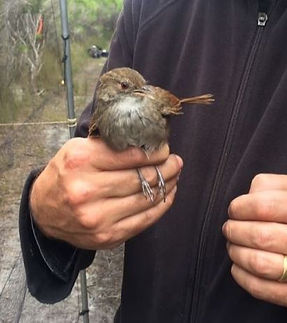
Eastern Bristlebird
Dasyornis brachypterus
Vulnerable

Norfolk Island Robin
Petroica multicolor
Endangered

Vanuatu Petrel
Pterodroma occulta
Critically Endangered
Fundamental ecology and management recommendations

Beck's Petrel
Pseudobulweria becki
Critically Endangered
Basic ecology and management recommendations. Partnership with the British Ornithologists Union and the University of Queensland.

Mallee Emu-wren
Stipiturus mallee
Endangered

Plains-wanderer
Pedionomus torquatus
Critically Endangered

Christmas Island Hawk-owl
Ninox natalis
Critically Endangered

Norfolk Island Morepork
Ninox novaeseelandiae undulata
Critically Endangered

Slender-billed White-eye
Zosterops tenuirostris
Endangered

Island systems we work to conserve

Ashmore Reef
Our work at Ashmore reef first began in 2000 and we have now published over 30 papers on this island system’s ecology, particularly the breeding seabirds. We hold long-term dataset on the biodiversity of seabirds and cetaceans in the area. This research has been critical in to inform the response to the 2009 Montara Oil Spill, and the ecological management of the Ashmore Reef Marine Park. More recently, we have worked with partners at Parks Australia, CSIRO, and UWA on a large-scale Ashmore Reef restoration project.

Browse Island
The work we do on Browse Island is closely paired with reserve management actions and aims to address key threatening processes on the island, primarily invasive rodents. Our research aims to promote the recovery of breeding seabird colonies and to inform future island restoration projects.

Christmas Island
On Christmas Island, we have used drones to monitor seabird colonies for a number of years. Due to range restrictions, Great Frigatebirds and Christmas Island Frigatebirds now nest in mixed colonies across the island. We have used fine-scale aerial imagery to investigate niche partitioning between these species. We have also recently commenced work on the Christmas Island Hawk-Owl, Christmas Island Goshawk, and Abbott's Booby.
.jpg)
Cocos (Keeling) Islands
Our work on Pulu Keeling National Park, located in the Cocos (Keeling) Islands, is focussed on improving monitoring outcomes for a variety of seabird species. The island supports one of the world's largest breeding colonies of Red-footed Booby, a focal species for our research on the island.

Great Barrier Islands
Our work on East Fairfax, Lady Elliot and Michaelmas Cay involves a long-term seabird monitoring program using drones and population counts. Our contributions are in partnership with the Department of Environment and Sustainability (DES). We also provide input to the scientific advisory group for Raine Island.
.jpg)
New Ireland
Our work in New Ireland is focussed on the enigmatic Beck’s Petrel. Here we aim to gather new ecological data to inform the conservation status and the conservation management of this species.
Photo credit: Jez Bird
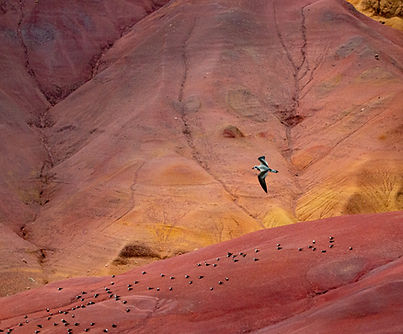
Norfolk Island group
Our team have worked extensively on Norfolk Island with all five endemic songbirds, the Norfolk Island Morepork and invasive rodents. We have also spent much time on the nearby Phillip Island investigating seabird movement, giant centipede ecology and island restoration.

Vanua Lava
Our work here in the Banks Islands in northern Vanuatu is focussed on the Vanuatu Petrel, revealing ecological insights that contribute to Island management more broadly.
